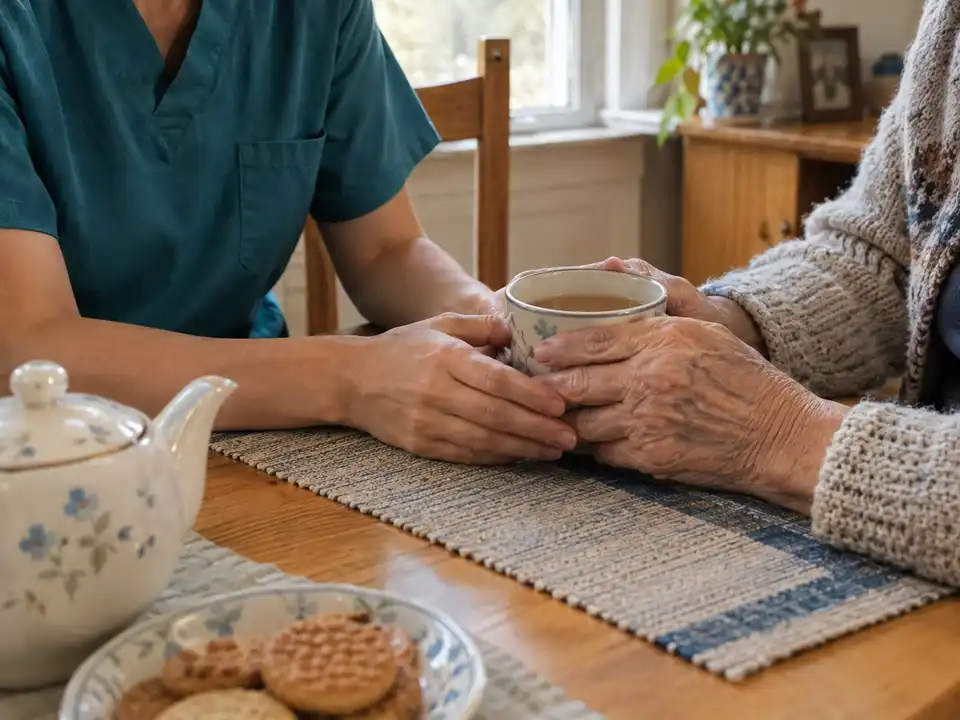
ReverseMortgagesOttawa.ca explains home care in Ottawa for owners 55 and older who want to keep living in the house they know. This page covers what the public system provides, the City programs that lower everyday costs, and how the value of your home can pay for more help when the public hours run short.
What publicly funded home care in Ottawa includes
Publicly funded home care in Ottawa is arranged by Ontario Health atHome, through its Champlain area office (Ontario Health atHome, Champlain area). A care coordinator assesses your needs first. That assessment decides which services you get and how quickly they start.
The services the Champlain area reports on include nursing, personal support, physiotherapy, occupational therapy, nutrition, social work and speech-language therapy (Ontario Health atHome, Champlain wait times). Anything beyond your assessed plan, such as extra companionship, overnight help or regular cleaning, is something you arrange and pay for yourself.
How fast care starts in the Champlain area
The province tracks how many patients get care within five days of their assessment. On August 31, 2026, the Champlain area reached 93.2% for nursing and 91.1% for personal support for patients with complex needs.
Some services have longer queues. The same report counted 1,204 people waiting for in-home physiotherapy, 568 for occupational therapy and 342 for social work. Only 24 people were waiting for personal support, and 7 for nursing.
City of Ottawa programs that help you stay home
The City runs several smaller programs that make keeping up a house easier (City of Ottawa, Help around the home).
- Home Support Services: light housekeeping, such as floors, bathrooms, laundry and the kitchen, for eligible low-income residents who have a medical need and few supports nearby.
- Snow Go: a matching service that connects residents 60 and older, or living with a disability, with someone to clear the driveway and walkway. You pay the contractor directly.
- Snow Go Assist: under the rules the City posted in 2025, it paid up to 50% of each snow clearing, to a maximum of $250 a season, or $450 for rural homes with very high costs. Income had to be below $40,000 for one person or $53,400 for a household (City of Ottawa, Get help clearing snow). The City hadn’t published the 2026-27 amounts when this page was checked.
- Library delivery: Ottawa Public Library staff bring books each month to borrowers who have been confined to home for more than three months.
Snow Go Assist applications go through local community support agencies, which the City lists by area.
An Ontario tax credit for care costs
If you or your spouse turned 70 or older this year, the Ontario Seniors Care at Home Tax Credit can return part of what you spend on care. It pays 25% of claimable medical expenses up to $6,000, so the most it pays is $1,500 a year (Government of Ontario).
Claimable means the eligible expenses above 3% of your net income. The credit shrinks by 5% of family net income over $35,000 and ends by $65,000 at most. Certified attendant care counts, along with items like walkers, grab bars and hospital beds. The credit is refundable, so you receive it even if you owe no income tax.
How home care compares with a long-term care bed
Long-term care has one price list across Ontario. From July 1, 2026, a basic room costs a resident at most $2,129.17 a month. A semi-private room tops out at $2,567.17 and a private room at $3,041.97 (Government of Ontario, Paying for long-term care). Fees, wait lists and help for low incomes are in the Ottawa long-term care cost guide.
Private home care has no published Ottawa price. Each agency sets its own hourly rate and minimum visit length, so ask two or three agencies for theirs before you choose.
Paying for extra care with a reverse mortgage
Ottawa owners aged 55 and older can pay for care from the value of their home with a reverse mortgage. It comes with no required monthly mortgage payments. You still look after the property tax, home insurance and upkeep. You go on living in the home, and it stays yours.
Money that arrives when the care bills do
You choose how the money comes: one lump sum, regular deposits, or a mix. Regular deposits often start around $1,000 a month, which suits care that’s billed every week or month. Interest is charged only on the money you’ve actually received.
What a typical Ottawa home could provide
| Type of home | Benchmark price | At 65 | At 70 | At 75 |
|---|---|---|---|---|
| Bungalow (one-storey house) | $630,100 -0.6% in a year | $319,000 | $333,000 | $364,000 |
| Two-storey house | $759,000 +0.4% in a year | $384,000 | $401,000 | $438,000 |
| Townhouse | $546,500 -2.2% in a year | $276,000 | $289,000 | $316,000 |
| Condo apartment | $380,800 -6.1% in a year | $192,000 | $201,000 | $220,000 |
| Typical Ottawa home (all types) | $623,500 -0.3% in a year | $315,000 | $330,000 | $360,000 |
Benchmark prices for September 2026 from the Ottawa Real Estate Board (MLS® Home Price Index: the price of a typical home of each type). Each amount is the benchmark times the age percentage the main estimate form uses (65: 50.55%, 70: 52.85%, 75: 57.75%), the top end of what the most generous products lend, to the nearest $1,000. The real figure for your home comes from its appraisal.
For example, the Ottawa Real Estate Board’s benchmark bungalow was $630,100 in September 2026 (OREB, September 2026). If the youngest owner is 70, that $630,100 home could provide up to about $333,000. Any mortgage still on the house is paid off from that amount first. The Ottawa reverse mortgage calculator gives a first figure for your own home.
Your benefits stay the same
Because the care money is borrowed, it doesn’t count as income, and no tax is due on it. Your Old Age Security (OAS) and Guaranteed Income Supplement (GIS) payments don’t change. A large sum left earning interest in a bank account is different, because that interest counts as income. Regular deposits avoid the problem.
If care needs grow
When both spouses are on the mortgage, nothing changes while either one still lives at home. The mortgage comes due when the last borrower sells, passes away or moves out for good, including a permanent move to long-term care. A hospital or rehab stay is not a move. If the house is left empty after that move, the guide to the Vacant Unit Tax and long-term care explains the yearly declaration.
What protects you and your family
You can never owe more than your home is worth when the mortgage comes due, as long as the property taxes, insurance and upkeep are kept up. This is typically called the no negative equity guarantee. All four lenders include it: HomeEquity Bank (CHIP), Equitable Bank, Home Trust and Bloom.
Interest is added to what you owe over time. Growth in your home’s value can offset some or all of it. Every one-time cost, from the appraisal to your own lawyer, is listed in the guide to what a reverse mortgage costs in Ottawa.
Help from a broker, from the first question to closing
For your Ottawa home, Richard Hopkins, Mortgage Broker, compares every reverse mortgage lender in Canada. The best deal for your home and goals arrives by email, with a son or daughter copied if you wish. You never need to visit an office. Richard is there for you by email, phone and video call.
You pay nothing for this help, since your chosen lender pays the brokerage once the mortgage funds. When the house needs changes for care, like grab bars or a main-floor bathroom, read about renovations that help you stay in your home.
What Richard handles for you
- Your care plans checked against every reverse mortgage lender in Canada
- How much your home could provide, after anything you still owe
- Regular deposits, a lump sum or both, timed to your care bills
- The best deal for your home and your care goals, by email
- Clear answers for the day one spouse moves into long-term care
- Your son or daughter copied on every email, if you like
- You never need to visit an office: help comes by email, phone and video call
- Advice that fits your situation, even when the answer isn't a reverse mortgage
Ottawa guides on this topic
- What does long-term care cost in Ottawa, and what happens to the house?
- Does Ottawa's Vacant Unit Tax apply when a parent moves into long-term care?
- What does a reverse mortgage cost on an Ottawa home?
Sources
Figures checked October 16, 2026.
- Ontario Health atHome, Champlain area
- Ontario Health atHome, Champlain wait times and waitlists (as of August 31, 2026)
- City of Ottawa, Help around the home
- City of Ottawa, Get help clearing snow (Snow Go and Snow Go Assist, rules posted in 2025)
- Government of Ontario, Ontario Seniors Care at Home Tax Credit
- Government of Ontario, Paying for long-term care (co-payments effective July 1, 2026)
- Ottawa Real Estate Board, September 2026 market update (published October 5, 2026)