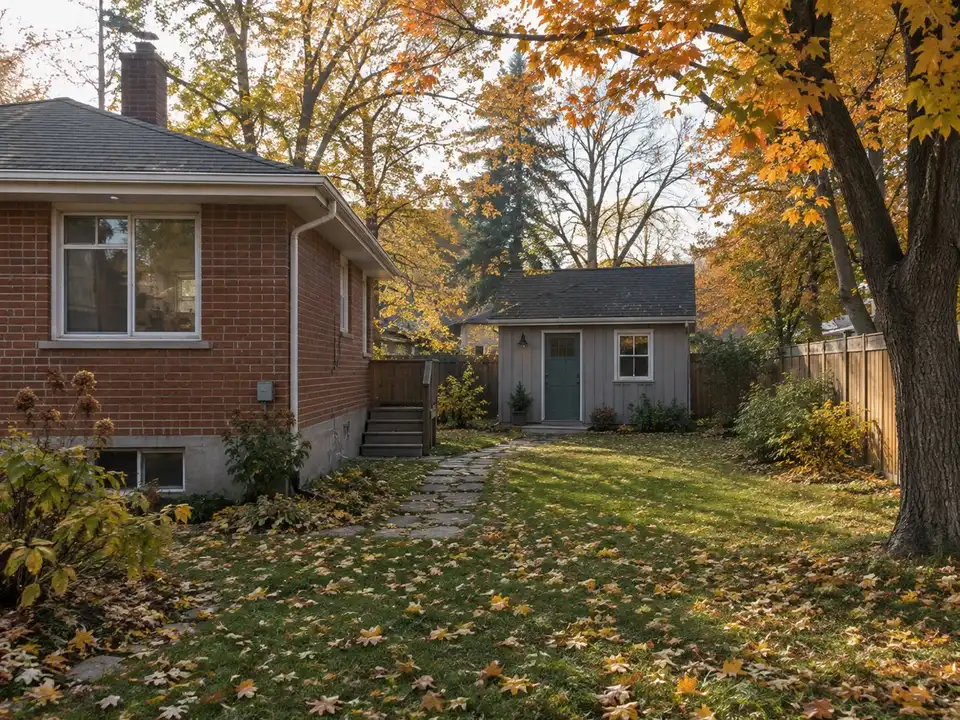
ReverseMortgagesOttawa.ca shows how a coach house in Ottawa can work for owners 55 and older who want someone close by. A second unit on your lot can mean a daughter living in the backyard, a caregiver close by, or rent coming in every month. This page covers the City’s rules, the taxes and credits, and paying for the work from your home’s value.
What the City of Ottawa allows
The City’s guidance under the older Zoning By-law 2008-250 lets a lot with a house have up to two additional dwelling units. That can be two apartments inside the house, or one apartment plus one coach house in the yard. The total can’t go over three units, counting your own (City of Ottawa, Adding a coach house).
The same City guidance adds these rules:
- Lots with a detached, linked-detached, semi-detached, duplex or townhouse home can apply.
- A lot on a private septic system or well is limited to one extra unit.
- In the urban area, a coach house connects to the main home’s City water and sewer.
- The largest unit you can build depends on the size of your lot and your house.
- No extra parking space is required. If you add one, it can’t go in the front yard.
- A building permit is always required, and some lots also need a minor variance from the Committee of Adjustment.
A basement apartment follows the same count. It needs its own ground-floor entrance unless the building and fire codes allow another way out (City of Ottawa, Adding an apartment).
The new zoning by-law changes the details
Ottawa’s new Zoning By-law 2026-50 was enacted on March 11, 2026. On July 2, 2026, the Ontario Land Tribunal ordered most of it into force, back-dated to March 11. Where a section is still under appeal, the stricter of the old and new rules applies (City of Ottawa, New Zoning By-law).
The final unit counts for extra dwellings under the new by-law weren’t confirmed when this page was checked. Before you pay a designer, ask the City which rules apply to your lot.
What Ontario law adds
Ontario’s More Homes Built Faster Act, 2022 (Bill 23) allows up to three units on many residential lots with full municipal services. Cities can’t charge development charges on those extra units, can’t set a minimum unit size, and can’t require more than one parking space per unit (Environmental Registry of Ontario, notice 019-6197). The City notes that education development charges still apply to a coach house.
Taxes, insurance and the Vacant Unit Tax
A new unit can change your yearly bills. The City’s coach house page names three to plan for:
- Property tax: the Municipal Property Assessment Corporation (MPAC) may reassess the home once the unit is added.
- Income tax: rent counts as income, so a paying tenant changes your tax return.
- Insurance: tell your insurer early, because the policy may need to change.
Ottawa also charges a Vacant Unit Tax. A unit is treated as empty when no one used it as a principal residence and it sat unoccupied for more than 184 days in the year. A home lived in by a family member as their principal residence, or rented for at least 184 days in stretches of 30 days or more, isn’t taxed (City of Ottawa, How the Vacant Unit Tax works). Every owner still files the yearly declaration. If the new unit could sit empty for long stretches, ask the City how it would be treated before that happens.
A federal tax credit for a family unit
The Multigenerational Home Renovation Tax Credit helps pay for a self-contained second unit that lets a senior, or an adult eligible for the disability tax credit, live with a qualifying relative. The Canada Revenue Agency’s page shows 14.5% of up to $50,000 in costs, for a credit of up to $7,250 per renovation, and the credit is refundable (Canada Revenue Agency, MHRTC). The rate for renovations finished in 2026 may be a little lower, so confirm it with your tax preparer.
What a coach house costs to build
There is no official price for a coach house in Ottawa. Costs vary widely with the size, the servicing, the lot and the finishes. Get detailed quotes from two or three builders, and ask each one to list the permit, design and connection fees.
Paying for the build with a reverse mortgage
Owners aged 55 and older can borrow against an Ottawa home to pay for a coach house, with no required monthly mortgage payments. You still cover the property tax, home insurance and upkeep. The house must stay your primary residence, meaning the place you live at least six months of the year.
How much an Ottawa home could provide
The amount depends on the youngest owner’s age and the home’s value. For example, OREB’s benchmark two-storey house was $759,000 in September 2026 (OREB, September 2026). If the youngest owner is 65, that $759,000 home could provide up to about $384,000. At 75, the same home could provide up to about $438,000. Any mortgage still owing is paid off first.
The guide to Ottawa house prices gives the benchmark for each type of home, and the Ottawa reverse mortgage calculator shows a first figure for yours. You never have to take the full amount.
A lump sum or money in stages
You can take one lump sum before the build starts, or a first amount and then more as the builder needs paying. Lenders typically ask for a first advance of roughly $20,000 to $25,000. Some lenders charge a small fee for each extra draw, and interest is charged only on what you’ve taken.
Rent and reverse mortgage money are taxed differently
Rent from the new unit is taxable income. The reverse mortgage money is a loan, so it isn’t. Mention the planned unit when you ask for your estimate, so every lender is compared on your real plans.
What stays protected
You can never owe more than your home is worth when the mortgage comes due, as long as the property taxes, insurance and upkeep are kept up. This is typically called the no negative equity guarantee, and all four lenders offer it.
Interest is added to what you owe over time, and growth in the home’s value can offset some or all of it. All four lenders, HomeEquity Bank (CHIP), Equitable Bank, Home Trust and Bloom, require independent legal advice with your own lawyer before closing. In Ontario that meeting usually costs about $800 to $1,200. Every other one-time cost is listed in the guide to what a reverse mortgage costs in Ottawa.
If the new unit raises your assessment, the guide to Ottawa property tax for seniors covers the City’s deferral program and Ontario’s grant for older homeowners.
Help from a broker, from the first question to closing
For a coach house plan, Richard Hopkins, Mortgage Broker, compares every reverse mortgage lender in Canada with your build in mind. You receive the best deal for your home and goals by email. Family members can be copied on every message. From your first question to closing, you never need to visit an office. Richard works by email, phone and video call. His help costs you nothing: the brokerage is paid by your chosen lender once the mortgage funds.
If a caregiver will live in the new unit, the page on paying for home care in Ottawa covers public care and the City’s help for older adults.
What Richard handles for you
- Your build plans checked against every reverse mortgage lender in Canada
- How much your home could provide for the build, after any mortgage owing
- A lump sum or staged advances, set up around your builder's schedule
- Your building plans taken into account from the start
- The best deal for your home and building plans, by email
- Family copied on every email, so everyone sees the same numbers
- Help by email, phone and video call; you never need to visit an office
- An option suited to your situation, even if that isn't a reverse mortgage
Ottawa guides on this topic
- What are Ottawa house prices in 2026, and what could your home provide?
- What does a reverse mortgage cost on an Ottawa home?
- How much is Ottawa property tax in 2026, and can seniors defer it?
Sources
Figures checked October 16, 2026.
- City of Ottawa, Adding a coach house (additional dwelling units in an accessory structure)
- City of Ottawa, Adding an apartment (additional dwelling units)
- City of Ottawa, New Zoning By-law (Engage Ottawa, updated July 8, 2026)
- Environmental Registry of Ontario, notice 019-6197 (More Homes Built Faster Act, 2022)
- City of Ottawa, How the Vacant Unit Tax works
- Canada Revenue Agency, Multigenerational home renovation tax credit (line 45355)
- Ottawa Real Estate Board, September 2026 market update (published October 5, 2026)